TL;DR
~/Library/Keyboard/VulgarWordUsage.dbis real. It records which swear words you use, per app and per recipient, so autocorrect learns to stop "ducking" you. On my Mac it is empty, and typing swear words into a native app did not fill it. On many Macs it doesn't exist at all, because of a missing folder (update below).- The words it tracks come from Apple's system dictionary, which flags every word with one of three tiers (vulgar, offensive, sensitive) and up to eleven topic flags (sex, drugs, religion, politics, violence, …).
- There is no public API for any of it. The flags can be read with a few private C functions from
Lexicon.framework. Code below, in C and in Swift. The full dumps for 15 languages are in this gist (uncensored, so mind the content warning). - Highlights: Oedipus is vulgar. Tom and Mick are offensive. pee, poo, niggle and underling are sensitive. And "Trump" is the only living politician in the English sensitive tier, next to Hitler, Mao, Osama bin Laden and the Taliban. Biden, Obama and Putin are clean.
Content note: this article prints the words uncensored, slurs included, because the article is about what Apple flags.
It started with a tweet
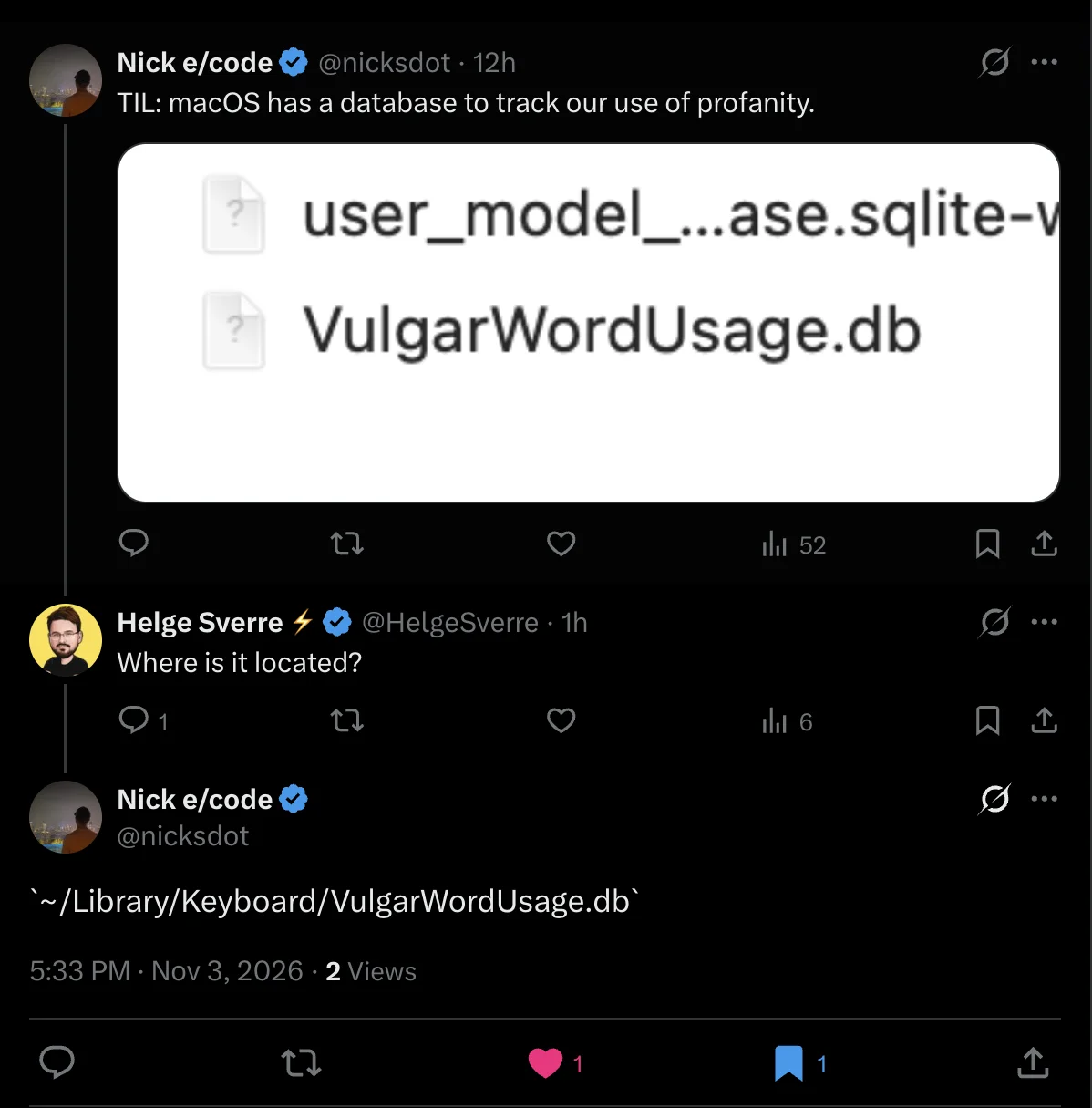
Nick posted this, I asked where it lives, and he answered. So I had Claude open mine.
The database
$ sqlite3 -readonly ~/Library/Keyboard/VulgarWordUsage.db .schema
CREATE TABLE properties (ROWID INTEGER PRIMARY KEY, key, value, UNIQUE (key));
CREATE TABLE IF NOT EXISTS "vword_usage" (
    ROWID INTEGER PRIMARY KEY AUTOINCREMENT,
    app                          TEXT, -- app identifier
    recipient                    TEXT, -- recipient identifier
    vword                        TEXT, -- vulgar word
    word_reading                 TEXT, -- the reading form of a word (relevant for Japanese)
    usage_count                  INTEGER DEFAULT 0,
    last_use_timestamp           REAL DEFAULT 0, -- last use timestamp (seconds since the reference date)
    journaled
);
CREATE UNIQUE INDEX app_recipient_vword_word_reading_idx ON vword_usage(app, recipient, vword, word_reading);
So the keyboard can know that you say fuck in Messages to one particular friend, but not in Mail to your boss. The
unique index is on (app, recipient, word, reading), so that is the granularity.
Mine is empty: no rows, a properties table holding only version = 2, and a modification date in April 2024.
What it is for
At WWDC in June 2023, Craig Federighi announced the iOS 17 autocorrect rewrite with this line: "In those moments where you just want to type a ducking word, well, the keyboard will learn it, too." (TechCrunch, NPR)
These function names from the macOS shared library cache show how the keyboard uses the database:
TI::VulgarWordUsageDatabaseWrapper::set_current_app_id(CFString)
TI::VulgarWordUsageDatabaseWrapper::set_current_recipient_ids(vector<string>)
TI::VulgarWordUsageDatabaseWrapper::increment_usage_count(word, reading, recipients)
TI::VulgarWordUsageDatabaseWrapper::decrement_usage_count(...)
TI::VulgarWordUsageDatabaseWrapper::can_autocorrect(word, app, recipients)
TI::VulgarWordUsageDatabaseWrapper::can_autocorrect_somewhere(word, reading)
KB::FilterNonVulgarIfTopCandidateVulgar::filter_candidates(...)
KB::Candidate::every_vulgar_word_is_allowlisted(VulgarWordUsageDatabaseWrapper*, ...)
Plus log strings like Passing recipient IDs to the vulgar word usage database wrapper; number of IDs: %lu.
- When you start typing, the keyboard engine tells the wrapper which app you're in and who you're writing to.
- When you type a vulgar word and keep it, its count goes up for that app and those recipients. Undoing the word brings the count back down.
- When the engine ranks suggestions, it asks whether every vulgar word in a candidate is allowlisted for this context. If it isn't, the clean alternative wins: ducking.
A _KSUserWordsSynchroniser sharedAcrossLanguagesVulgarWordUsageValue symbol suggests it syncs between devices like
your other learned words.
Mine is empty
Claude tried to fill it, using agent-desktop to open a new TextEdit
document and type well fuck this shit, damn it., first as a text insert, then as individual key presses. Nothing
changed: no row, no log line, and the file's modification date stayed in 2024.
Update: why the file is missing on many Macs
On Hacker News, swiftcoder reported that neither the database nor the
~/Library/Keyboard folder exists on their macOS Tahoe install.
dr_pardee had the same problem, saw that macOS was trying to write the
file and failing, and had Claude work out why. The prompt they used is in
their gist.
The cause is a missing folder. AppleSpell, the background service behind autocorrect, opens
~/Library/Keyboard/VulgarWordUsage.db the first time a text field asks it for predictions in a given language. SQLite
creates a database file when it's missing, but not the folder it lives in. Without ~/Library/Keyboard, the open fails
with "no such file or directory", AppleSpell logs a com.apple.libsqlite3 error naming the path, and it carries on
without the database. There's no visible error, so the feature stays off on that Mac without anyone noticing.
To get the file, create the folder, restart AppleSpell and type a sentence in a native app such as TextEdit:
mkdir -p ~/Library/Keyboard
kill -9 $(pgrep AppleSpell)   # per the gist, a plain kill is ignored; macOS relaunches it on demand
On my Mac the folder already existed (it dates from 2023), so the database was created normally in April 2024. The gist also explains why mine is empty: a row is only written when autocorrect offers to replace a vulgar word and you keep the original. A correctly spelled swear word never gets a correction, so there is nothing to count, which fits my TextEdit test where every word was spelled correctly.
The database only counts words that are already marked as vulgar somewhere else, so the next step was finding that list.
Where the word list lives
Searching the dyld shared cache for "vulgar" turned up a C API with an LX prefix (LXVulgarWordUsageDatabaseCreate,
LXVulgarWordUsageDatabaseCanAutocorrect, …) and, more usefully, two functions on dictionary entries:
_LXEntryGetCategoryFlags
_LXEntryGetMetaFlags
LX is Lexicon.framework, a private framework that reads the per-language dictionaries under
/System/Library/LinguisticData/. Every word in those dictionaries is an LXEntry with two 32-bit flag fields. If the
vulgarity rating is anywhere, it's in those bits.
There is no public API
NSSpellChecker, UITextChecker, NaturalLanguage and UILexicon don't expose vulgarity. SensitiveContentAnalysis
covers images and video, not text. The only places "profanity" shows up on developer.apple.com are App Store age ratings
and review guidelines.
Lexicon has no headers, but the C functions are exported, and their signatures are easy to guess because they follow CoreFoundation conventions. This program opens the dictionary for a locale, walks every entry, and prints both flag fields:
// lx.c — dump every word in a system lexicon with its flags.
// clang -O1 -o lx lx.c -F/System/Library/PrivateFrameworks -framework Lexicon -framework CoreFoundation
#include <CoreFoundation/CoreFoundation.h>
#include <stdbool.h>
#include <stdio.h>

typedef const void *LXLexiconRef, *LXCursorRef, *LXEntryRef;
extern CFStringRef kLXLexiconLocaleKey;
LXLexiconRef LXLexiconCreate(CFDictionaryRef options, CFErrorRef *error);
LXCursorRef  LXLexiconCreateRootCursor(LXLexiconRef);
void         LXCursorEnumerateEntriesRecursively(LXCursorRef, void (^)(LXEntryRef, bool *stop));
CFStringRef  LXEntryCopyString(LXEntryRef);
uint32_t     LXEntryGetCategoryFlags(LXEntryRef);
uint32_t     LXEntryGetMetaFlags(LXEntryRef);

int main(int argc, char **argv) {
  CFStringRef locale = CFStringCreateWithCString(NULL, argc > 1 ? argv[1] : "en_US", kCFStringEncodingUTF8);
  const void *keys[] = {kLXLexiconLocaleKey}, *values[] = {locale};
  CFDictionaryRef options = CFDictionaryCreate(NULL, keys, values, 1, &kCFTypeDictionaryKeyCallBacks,
                                               &kCFTypeDictionaryValueCallBacks);
  LXLexiconRef lexicon = LXLexiconCreate(options, NULL);
  if (!lexicon) return 1;

  LXCursorEnumerateEntriesRecursively(LXLexiconCreateRootCursor(lexicon), ^(LXEntryRef entry, bool *stop) {
    char word[512] = "";
    CFStringRef s = LXEntryCopyString(entry);
    if (s) { CFStringGetCString(s, word, sizeof word, kCFStringEncodingUTF8); CFRelease(s); }
    printf("%08x\t%08x\t%s\n", LXEntryGetCategoryFlags(entry), LXEntryGetMetaFlags(entry), word);
  });
}
$ ./lx en_US | wc -l
  199019
$ ./lx en_US | awk -F'\t' '$3 == "fuck" || $3 == "table" || $3 == "Trump"'
00000000	00800002	fuck
00000000	00000000	table
00002000	02000081	Trump
The same thing in Swift, loading the functions at runtime with dlopen and dlsym so you don't need to link against a
private framework. It prints only words that carry one of the three tiers:
// lexflags.swift — swiftc -O lexflags.swift -o lexflags && ./lexflags en_US
import Foundation

let lexicon = dlopen("/System/Library/PrivateFrameworks/Lexicon.framework/Lexicon", RTLD_NOW)!
func sym<T>(_ name: String, as _: T.Type) -> T { unsafeBitCast(dlsym(lexicon, name)!, to: T.self) }

typealias LXRef = UnsafeRawPointer
let create     = sym("LXLexiconCreate", as: (@convention(c) (CFDictionary, UnsafeMutablePointer<Unmanaged<CFError>?>?) -> LXRef?).self)
let rootCursor = sym("LXLexiconCreateRootCursor", as: (@convention(c) (LXRef) -> LXRef?).self)
let enumerate  = sym("LXCursorEnumerateEntriesRecursively", as: (@convention(c) (LXRef, @convention(block) (LXRef, UnsafeMutablePointer<Bool>) -> Void) -> Void).self)
let copyString = sym("LXEntryCopyString", as: (@convention(c) (LXRef) -> Unmanaged<CFString>?).self)
let metaFlags  = sym("LXEntryGetMetaFlags", as: (@convention(c) (LXRef) -> UInt32).self)
let category   = sym("LXEntryGetCategoryFlags", as: (@convention(c) (LXRef) -> UInt32).self)
let localeKey  = dlsym(lexicon, "kLXLexiconLocaleKey")!.load(as: CFString.self)

let locale = CommandLine.arguments.dropFirst().first ?? "en_US"
guard let lex = create([localeKey: locale] as CFDictionary, nil), let root = rootCursor(lex) else {
    fatalError("could not open lexicon for \(locale)")
}

let tiers: [(UInt32, String)] = [(0x0080_0000, "vulgar"), (0x0100_0000, "offensive"), (0x0200_0000, "sensitive")]
enumerate(root) { entry, _ in
    let meta = metaFlags(entry)
    guard let tier = tiers.first(where: { meta & $0.0 != 0 })?.1,
          let word = copyString(entry)?.takeRetainedValue() else { return }
    print(tier, String(format: "%05x", category(entry)), word, separator: "\t")
}
Both are read-only. They open the same dictionary the keyboard uses and print it.
Decoding the bits
Apple doesn't document these flags, so every meaning below is inferred: Claude grouped words by bit and read samples
until each group's theme was obvious. The system code helps with one of them. An enum case called
offensiveVulgarSensitive sits right next to the vulgar-word code, and three adjacent meta bits match it.
The three tiers (meta flags)
| Bit | Tier | en_US words | Examples |
|---|---|---|---|
0x00800000 | vulgar | 1,050 | fuck, shit, cunt, cock, crap, wtf, fml, bullshitting, fucktard, shizzle, merde |
0x01000000 | offensive | 663 | kike, wop, dago, fag, Paki, japs, Klansman, retard, Oriental, ass, asshole |
0x02000000 | sensitive | 2,558 | damn, bitch, idiot, LSD, abortion, gun, suicide, anus, pee, poo |
In en_US a word has at most one tier: they never overlap. Out of 199,019 entries, 4,271 have one.
Roughly: vulgar is swearing and sex slang, offensive is slurs aimed at groups of people, and sensitive is everything a keyboard shouldn't offer you unprompted: mild swears, insults, drugs, weapons, extremism, disease and bodily functions.
The topics (category flags)
The other field is a topic bitmask, and a word can have several topics:
| Bit | Topic | en_US words | Examples |
|---|---|---|---|
0x00100 | excretion | 123 | feces, barf, crapper, piddle, pooped |
0x00200 | body parts | 958 | nipples, navel, buttock, perineum, triceps |
0x00400 | insults, identity-loaded | 823 | idiot, cretin, hick, pleb, sexist, homophobic, blacklist |
0x00800 | disease | 93 | Covid, herpes, PTSD, leprosy, monkeypox |
0x01000 | drugs | 222 | heroin, shroom, crackhead, hotbox, OD |
0x02000 | politics, extremism | 266 | Hamas, Goebbels, Leninism, democrat, swastikas, Trump |
0x04000 | religion, damnation | 420 | Sikhism, jihadi, Beelzebub, damn, hell, jeez |
0x08000 | sex | 473 | nude, nookie, lecher, harlots, Pornhub, Hooters |
0x10000 | violence, death | 373 | suicide, lynch, murders, hangings, slave, slaveholder |
0x20000 | weapons, terrorism | 268 | AK-47, grenadier, jihad, sarin, kamikaze, yellowcake |
0x40000 | catch-all "sensitive context" | 1,080 | God, Allah, Jews, gay, trans, bi, crazy, fat, ugly, sex, die |
The topic flags and the tiers are independent. 2,052 English words have a topic but no tier: gay, fat, God, Allah and sex are all tagged "sensitive context" but are not vulgar, offensive or sensitive. My guess is the topic is a hint ("be careful how you rank this") and the tier is the rule.
The lower meta bits are dull: proper nouns, abbreviations, camel-case brand names like iMac and tvOS.
The weird ones
Vulgar
Next to the expected orgy, sext and merde:
- Oedipus: vulgar. Presumably because of motherfucker-adjacent jokes, or the complex.
- reams: vulgar. As in "to ream someone".
- cooties: vulgar, presumably from playground use.
Offensive
- Tom and Mick: offensive. Uncle Tom and the slur for Irish people, but also very common first names.
- Oriental: offensive.
- papooses: offensive.
- conservatards: offensive, the only political insult in the slur tier.
- niggardly: offensive. It means "stingy" and comes from Old Norse, unrelated to the slur. It has also caused real controversies, which is presumably why it's there.
- ass and asshole: offensive, not vulgar.
Sensitive
- pee and poo: sensitive, with the excretion topic. So are premenstrual, leprosy and herpesvirus.
- niggle (a small worry, of Scandinavian origin) and underling (Old English for a subordinate) are sensitive and share the insult topic. Similar words aren't flagged: snigger is clean but niggle is flagged, and minion, lackey, flunky and stooge are clean but underling is flagged. These look like hand-picked entries, not rules.
- blacklist and whitelist are sensitive with the insult/identity topic. That matches the industry move to
blocklist and allowlist. Apple's own phrase-filter files are named
blocklist.dat. - Braves and Chiefs (team names with Native American mascots), Londonderry (the contested name for Derry), Gentile, Jehovah, Mongol and Frenchier are all sensitive.
- Isis is sensitive with the politics topic (the terror group, not the goddess).
- slave, slavery and slaveholder are sensitive with the violence topic.
- idiot is sensitive in English. Norwegian is stricter and puts idiot in the offensive tier.
The Trump flag
The sensitive tier has 109 capitalized words. Here is all of it:
Al-Qaeda, Al-Qaida, Aryan, Aryans, Auschwitz, Bacchus, Beelzebub, Birkenau, Brave(s), Buchenwald, Chief(s), Chippendale(s), Christ-y, Christer(s), Crip(s), Dachau, Eichmann, Frenchier, Gentile(s), Gestapo(s), Goebbels, Goering, Hamas, Hezbollah, Himmler, Hitler, Hitlerian, Hitlerism, Hitlerite(s), Hitlerjugend, Hooters, Isis, Islamophobe(s), Islamophobic, Jehovah(s), Jewfro(s), Jezebel(s), Kalashnikov(s), Kristallnacht, Kuomintang, Londonderry, Luftwaffe, Mao, Mauthausen, Mickie(s), Mollie(s), Mongol(s), Mossad, Nazi(s), Nazism, Osama, Pornhub, Quaalude(s), Reich, Reichsmark, Reichstag, Sachsenhausen, Satan, Satanism, Shoah, Sinophobe(s), Sinophobic, Sodom, Stasi, Taliban, Treblinka, Trump, Trumps, Unabomber, Uzi(s)
(Plurals and possessives folded for brevity.)
Every other real person on that list is dead, and nearly all of them are Nazi officials, dictators or terrorists. Trump is the only living exception:
category  meta      word
00002000  02000081  Trump        sensitive tier + politics topic
00002000  02000081  Trumps
00002000  02000081  Trump's
00000000  00000000  trump        (the card-game word: clean)
00000000  00000000  trumped
For comparison:
| Word | en_US |
|---|---|
| Trump | sensitive, politics topic |
| Hitler | sensitive, politics topic |
| Biden | clean |
| Obama | clean |
| Putin | clean |
| Stalin | clean |
| Musk | not in the dictionary |
en_GB matches en_US. Other languages differ: the German dictionary has Trump clean (and puts Hitler in the
offensive tier), and Swedish flags Putin as sensitive.
What the flag does matters here. As far as I can tell, a sensitive word is one the keyboard shouldn't suggest on its own. You can still type it and it won't be corrected away. It stays out of the QuickType bar unless you're already typing it, which is much milder than a ban.
There is a plausible reason Apple would want that for one specific name. In February 2025, iPhone dictation briefly showed "Trump" when people said "racist". It went viral, and Apple called it a "phonetic overlap" in the speech model and shipped a fix within a day (9to5Mac). The dictionary files on my Mac are from July 2025. A rule that keeps the name out of unprompted suggestions would stop that kind of thing from happening again through the keyboard.
Norwegian politics, for comparison
Because I'm Norwegian and had to check:
| Word | Topic | Tier |
|---|---|---|
| FrP, Høyre, Venstre, Rødt, SV, KrF, MDG | politics | none |
| Støre | politics | none |
| Solberg, Erna, Sylvi | none | none |
| Listhaug | n/a | not in the dictionary |
| Breivik, Quisling, Hitler | none | sensitive |
Every party gets the politics topic and none gets a tier. The only Norwegians in the sensitive tier are a mass murderer and a Nazi collaborator.
Other languages
The same three tiers exist in every European dictionary we tried, Cyrillic included. The counts are entries, not lemmas, so heavily inflected languages like Polish and Russian look much worse than they are: every case and conjugation of a swear word is a separate entry.
| Locale | Vulgar | Offensive | Sensitive | Notable |
|---|---|---|---|---|
| en_US | 1,050 | 663 | 2,558 | idiot is sensitive |
| en_GB | 1,055 | 872 | 2,337 | chav is offensive; chink is filed as vulgar, not offensive |
| nb_NO | 2,393 | 1,324 | 6,446 | idiot is offensive |
| da_DK | 1,179 | 3,314 | 8,551 | fjols ("fool") is offensive |
| sv_SE | 637 | 1,247 | 16,193 | idiot is vulgar; Putin is sensitive |
| fi_FI | 569 | 872 | 47 | The entire sensitive tier is kakka ("poop"), kakkakasa ("pile of poop") and saakeli |
| de_DE | 3,218 | 3,518 | 9,446 | Hitler and beknackt ("daft") are offensive; Trump is clean |
| nl_NL | 57 | 1,180 | 3,805 | Only 57 vulgar words, but kanker ("cancer", the classic Dutch swear) is one |
| fr_FR | 2,151 | 262 | 5,562 | boche is offensive |
| es_ES | 3,931 | 313 | 13,431 | sudacas and fachas are offensive |
| it_IT | 3,886 | 377 | 6,543 | terrone is offensive, and so is nazismi |
| pt_BR | 1,590 | 1,891 | 3,332 | machista and velhinhos ("little old people") are offensive |
| pl_PL | 9,698 | 1,436 | 6,190 | The biggest vulgar tier here, mostly inflections (dupczysz, srasz) |
| ru_RU | 10,821 | 3,239 | 24,721 | Same story: мат inflects a lot |
The bits don't seem to mean the same thing everywhere. Arabic and Hebrew return hundreds of thousands of "sensitive" entries, so those dictionaries probably reuse the bits for something else, so they're left out. Korean, Catalan and Hungarian return nothing, and Japanese crashes the dumper.
Samples from Norwegian, since that's what I type in when I'm not typing English:
- Vulgar: faen, jævla, dritt, fitte, kuk, pule, pissehull, rævhull, pulekanin, kåt, morrabrød.
- Offensive: idiot, sigøyner, kinamann, riskokers (literally "rice cookers", a slur for Asians).
- Sensitive: helvete, satan, homo, quisling, Breivik, skinhead, abortnekt, trusene ("the panties").
Phrases, not just words
There is a second, separate filter. Every English language model has a blocklist.bundle, and there's a
qp_blocklist.bundle for QuickPath, the swipe keyboard:
/System/Library/LinguisticData/RequiredAssets_en.bundle/AssetData/en.lm/
├── blocklist.bundle/{blocklist.dat, blocklistidmap.dat}
└── qp_blocklist.bundle/{blocklist.dat, blocklistidmap.dat}
blocklistidmap.dat is a 20-byte header followed by (lexicon token ID, class ID) pairs of 32-bit integers. Mapping
the token IDs back through the dictionary gives 2,544 words in 930 classes. Most classes are inflection groups:
931   fuck | fucked | fucking | fucks
1181  molest | molestation | molested | molester | molesting
1514  died | dies | dying
1611  Holocaust | holocaust | holocausts
1614  denied | denies | deny | denying
923   Semite | Semites | Semitic
1487  ghetto | ghettoes | ghettos
1720  animals | brown | cats
blocklist.dat is a packed trie over those class IDs, so it blocks sequences: "deny" followed by "Holocaust", and
whatever 1720 pairs with. A class that puts brown next to animals and cats suggests the list targets specific
phrasings rather than single words, though which phrasings can't be told without decoding the trie. The runtime check is
LMLanguageModelTokenSequenceIsBlocklisted in LanguageModeling.framework. Claude got far enough to learn that its
fourth and fifth arguments include an output pointer, but its probe still crashes intermittently, so the actual phrases
haven't been read yet. That's for a follow-up.
Caveats
- Meanings are inferred. Apple documents none of these bits. The tier names come from an enum in the system code and the topics from reading thousands of samples. Both readings are consistent across samples, but neither is confirmed.
- Flagged is not censored. As far as I can tell these flags decide what the keyboard volunteers, not what you can type.
- One machine. Everything here comes from macOS 15.6 (24G84) with LinguisticData build 438 from July 2025. iOS and other macOS versions may ship different dictionaries.
- Private API. The functions can change or disappear in any update. Don't ship this in an app.
Try it yourself
# Your own learned-swears database (probably empty on a Mac)
sqlite3 -readonly ~/Library/Keyboard/VulgarWordUsage.db 'select * from vword_usage'

# Build the Swift version from above and filter by tier
swiftc -O lexflags.swift -o lexflags
./lexflags en_US | awk -F'\t' '$1 == "vulgar" {print $3}' | sort -u | less
./lexflags nb_NO | awk -F'\t' '$3 == "faen" || $3 == "helvete" || $3 == "idiot"'
If you'd rather not build anything, the gist has every tiered word for 15 locales as TSV, plus the code and a script that regenerates them. It's a snapshot of macOS 15.6 and won't be kept up to date.
If you find something funnier than Oedipus, I want to hear about it.